APA recently released a new set of FIVE new professional sample papers. Imagine my excitement! After spending months seeking out random papers to check and test RefRunner, I get a treasure trove right from the source! RefRrunner did a pretty good job, but I found a few bugs and a few improvements. And now, I’m ready to start showing off just how much everyone needs RefRunner.
I’m quite sure that the good folks at the APA did due diligence on these papers, but even they don’t have the time to go out and check every URL and every detail. Some of these fixes likely crept in over the years since some of their starting points were released. You might think that once you’ve got a reference right, you don’t need to change it again, but you might just be surprised.
Wrong Title
This article, which has a DOI (https://doi.org/10.2307/357382), is easy for RefRunner to validate. It can jump straight to the crossref API page for the paper and get all the info.
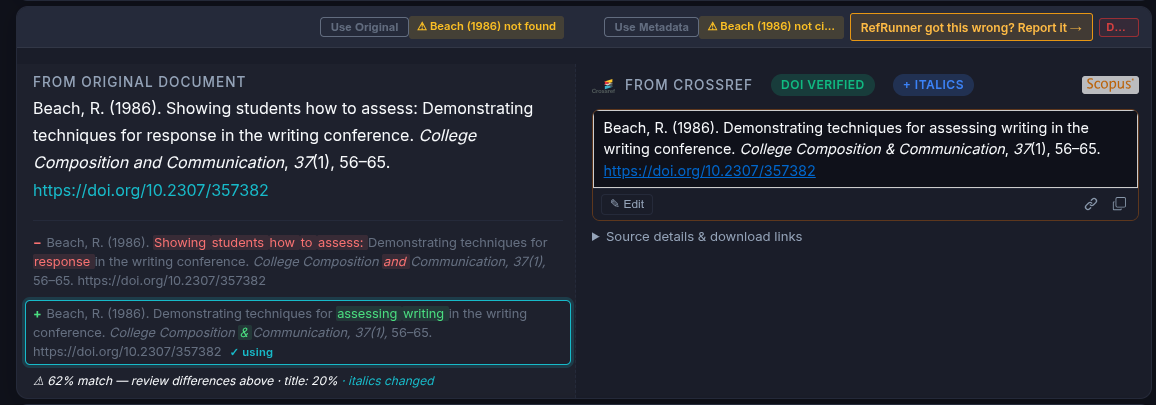
You don’t need to take RefRunner’s word for it though (sometimes the metadata are wrong!), the DOI link is right there; clicking it opens it in a new window and you can see for yourself. I’ll admit I was surprised.
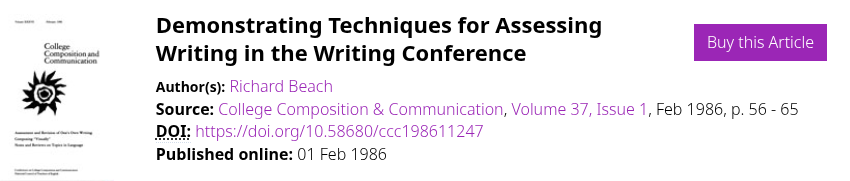
This one bothered me, as it didn’t make sense that the person preparing this document for the APA would make such a mistake. The same author does have a piece with that name in an edited volume— Beach, R. (1989). Showing students how to assess: Demonstrating techniques for response in the writing conference. In C. M. Anson (Ed.), Writing and response: Theory, practice, and research (pp. 127-148). National Council of Teachers of English.
Another change is the ampersand in the journal title rather than the word “and.” My understanding is that you’re supposed to use what the journal uses, and we can see here that the journal is a fan of the ampersand.
Finding a DOI
I included this one mostly because we replaced the author’s URL. The URL does open up a PDF of the paper, so most people would stop looking at this point. But not RefRunnner.
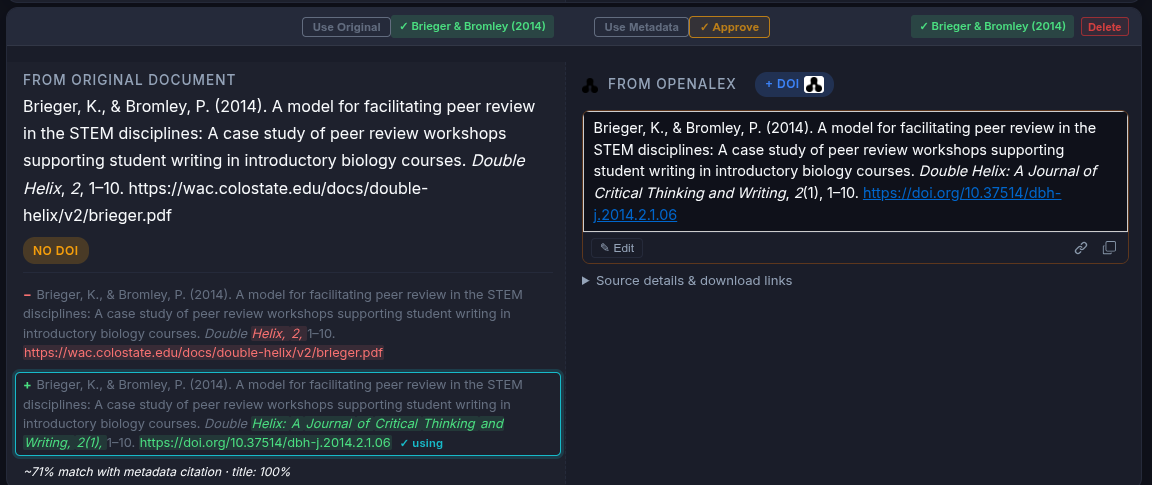
search at https://openalex.org/ finds the article, which has now been assigned a DOI. As time goes on, more and more publishers backfill their catalogs, and works that didn’t have a DOI when the article was released, get assigned one. In this particular case, however, the DOI is rather unsatisfying—it redirects to the table of contents for the issue, and though each article has its own DOI, theyartc all redirect to the TOC.  Worry not! The URL that resolves isn’t all that’s in a DOI—we still get the metadata, so we can confirm all the information in the reference (and write it in other styles if we wish).
Books are Hard. How about a pretty DOI?
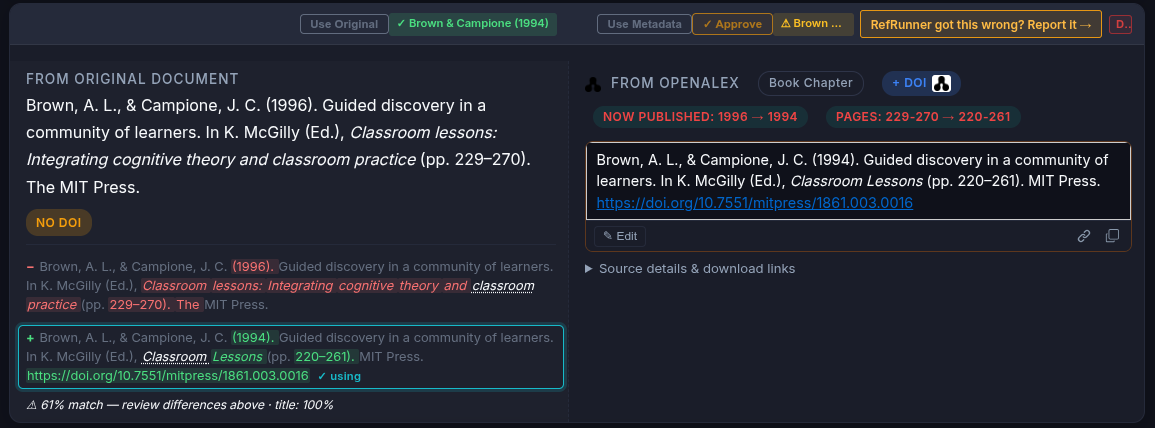
Books are the hardest type of reference to get right. They have multiple editions. Publishers are bought and sold, changing the publisher name, and using new names in their metadata. A book can have a paper publication date, and then another one ten years later for the exact same book, but now it’s electronic. Would you rather link to the copy that you found yourself in the library stacks (or on your shelf) or let someone retrieve it with a couple of clicks? Here they’ve cited the paperback edition, but RefRunner retrieved the first edition. For the record, that’s the one in my own bibliographic library—I checked! Strangely, mine has yet a third range for the page numbers: 229–309. According to my records, I did have a paper copy; it’s not clear that I double-checked the page numbers against the paper copy once I retrieved it.
So, in this case, the APA-supplied reference isn’t wrong, but RefRunner’s might be better. If you’re checking someone else’s work, even without further searching it’s a pretty good bet that the 1996 version exists.
An Unsatisfying Attempt To Replace a Broken URL with a Functioning URL
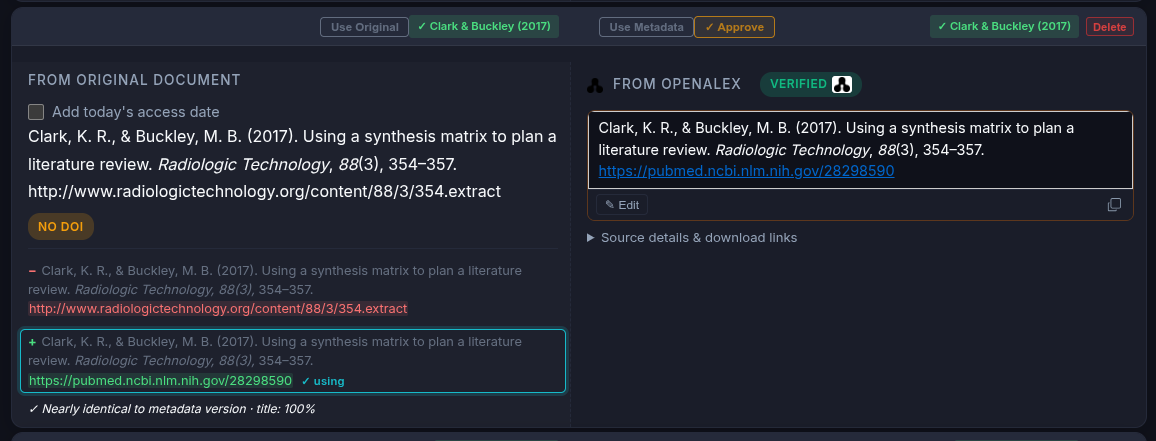
Here’s another URL that was likely correct and rotted over time. The URL now redirects to the journal’s home page, and from there you can try to find the article there. What we present instead, though, is a PubMed record for the article, which seems like good evidence. It turns out that the PubMed record is just a placeholder, and that if you search for the article on the journal page, there’s no evidence of it. But wait! If I take the URL from the reference, and replace “extract” with “abstract”, we get this: Radiologic Technology Volume 88, Number 3 Article, and that confirms the title. I guess the PubMed URL provides a bit more information? There is another reference from the same publication with the same pattern; we provide a PubMed record, but no evidence for the article exists on the site.
Inserting the Journal Name
Here they supply an ERIC link, but suggest that “ERIC” as if it were the source, rather than The Writing Instructor, a now-defunct website. The PDF ERIC supplies is a PDF generated from a web page. It’s pretty remarkable that it’s possible to find this at all almost 20 years later.
Validate a Website
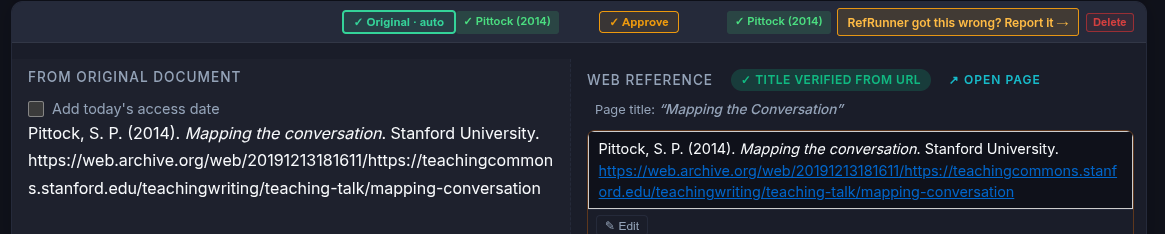
RefRunner can’t always do this because not all websites will provide the title in the metadata as they should, but when they do, it’s very satisfying to see a confirmation that the website title matches the reference without having to go check for yourself. Often these checks fail because the site requires clicking through a page, or the title is a generic one for the site and not the page in question.
Supply a URL
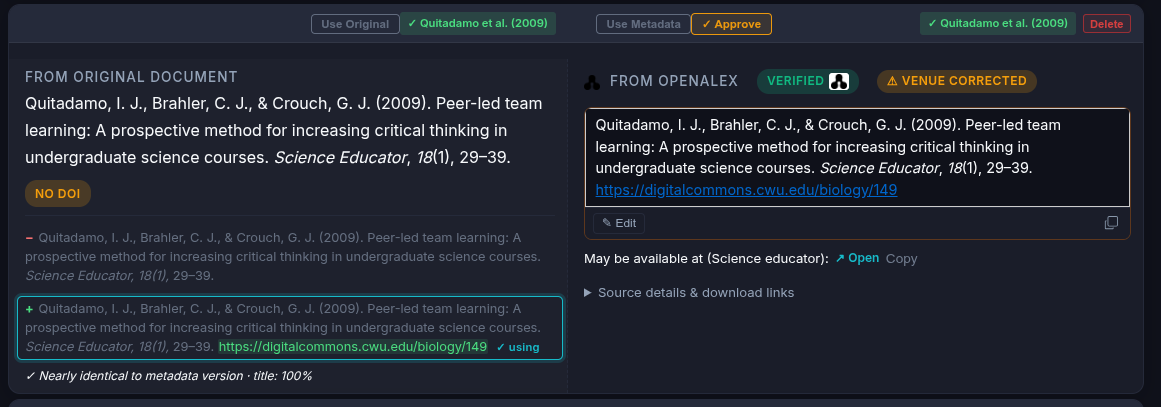
One of the remarkable things about OpenAlex is that it consumes a bunch of university repositories. For this reference, the repository owners even provide the correct metadata for the journal name, year, volume, and page numbers! You’ll need a cwu.edu login to download the artiurrcle, though. The Science Educator website requires a login to see much of anything.
Tracking Down an ERIC ID
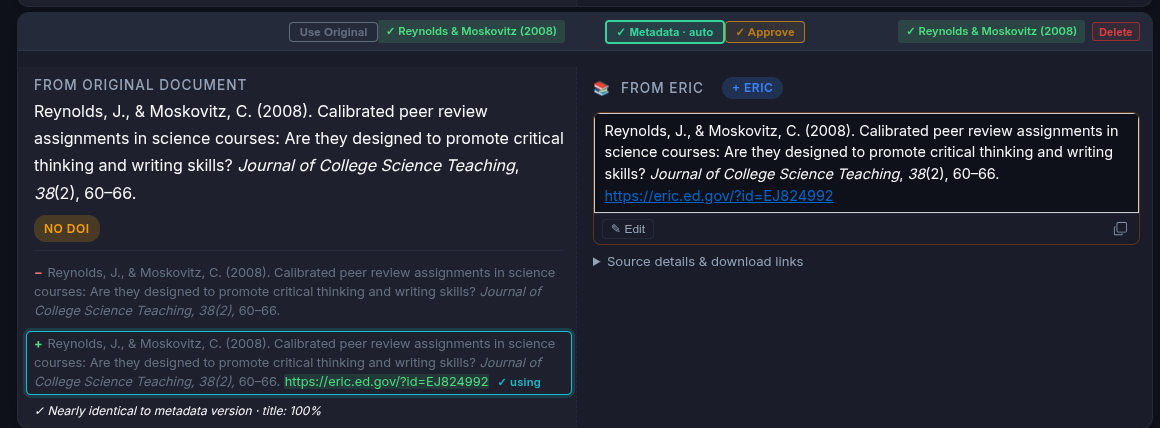
RefRunner validates this reference existence and lets you see for yourself at the ERIC archive.
Thanks, APA!
There are a handful of other small things, like a 2003 Erlbaum book that the Website claims is Routledge; whether you want the publisher’s current name or the one in the book is what you want is up for grabs. RefRunner goes with the record at the Library of Congress!
This document provides a great example of why people need a tool like RefRunner. All of these references were carefully prepared, and at one point, were probably correct. RefRunner makes it possible to check almost all of them, and provides links for you to check its work.