Support for Google Docs and Dropbox links
A user reported that they collaborated with co-authors using Google Docs and Zotero, “But then right as I approached the submission deadline zotero glitched out on me. I put the paper into refRunner and it got enough of the reference list to get me over the goal line.”
So now, if you want to collaborate with people using Google Docs or Dropbox, you can paste in a share link and RefRunner will check your file. You can then make changes, fixing references or the in-text citations pointing to them, save, click reload button and RefRunner will check it again.
Your document is loaded directly to your browser, not through our servers, and your link stays on your machine. That said, if you do want to share a document to demonstrate RefRunner needs improvement, a Google Docs or Dropbox link is a handy way to do that!
Building a shared reference list is as easy as pasting a link.
Got other ideas for how to make RefRunner support your workflow? Let me know!
Improved pasting of formatted references
When I was testing the Google Docs workflow, I found that the pasted references had botched formatting. I worked for a while and now whether you copy/paste a formatted reference at the bottom of the page, click the copy icon on the editor on the reference card, or click in that editor, select all, and then copy, when you paste, it goes right in and matches the formatting in your document. I tested on Google Docs and LibreOffice. If you have trouble please let me know and provide details about what browser, software, and OS you’re using.
Easier to copy and download reference list
The File menu at the top of the page now includes Copy and all of the download options (.docx, BibTeX, RIS, …), so you no longer need to scroll down below the reference cards to find those download buttons.
Better support for anonymized reviews
Blind-review placeholders (“Author”, “Author2 (XXXX)” and so on) are much improved. They should just do the Right Thing. If you have examples that you think should work that RefRunner gets wrong, let me know!
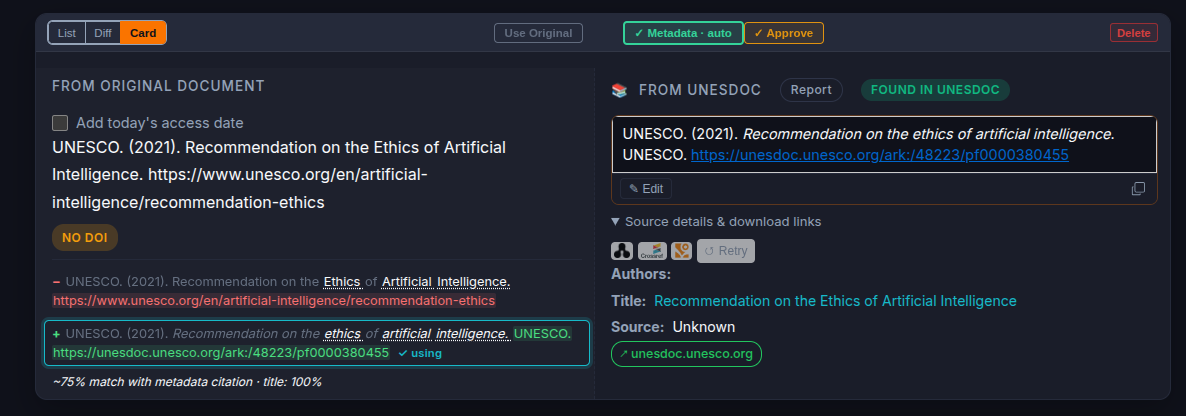
UNESCO documents validated directly from UNESCO
About 5% of users with saved reference lists cite UNESCO documents, and citations to those documents usually have the scary NOT FOUND ANYWHERE badge, even if there is a URL. UNESCO has an API, and now we search it and build the reference that includes UNESCO’s own permalink. If your title is in a different language, RefRunner will find it, but the reference produced will be in English. If that’s an issue for you, let me know!
Things you won’t notice
Lots of time is spent making RefRunner do a better job finding hard-to-find citations and improving how references are produced. It’s, well, pretty boring, but the fact that these changes are hard to appreciate points to what a good job RefRunner is doing already.
Title in another language
When a DOI’s record agrees with your citation on everything except the title, and the title is in another language, the card says so instead of asking whether the DOI is wrong. Lithuanian, Portuguese and Spanish journals that deposit the English title were all getting the wrong-DOI question. Crossref supports including titles in multiple languages, but in practice, few publishers deposit multiple titles.
Improved handling of books
Books are hard. They have multiple publication years, subtitles, different publishers for different editions, publishers that go by many names, and that’s just the obvious part. RefRunner can get book information from Crossref, OpenAlex, OpenLibrary, and Library of Congress. The library of congress is generally the most correct, except, as I learned this week, when it’s not. Sometimes records for books not-yet at the Library of Congress get created and they, well, can be a mess.
- An APA 7 entry of the form “Title. Publisher.” is read as a book, whoever the publisher is, so it is looked up in library catalogs rather than as an article. (Figuring out if it’s a book or a journal online-first with no volume or page numbers is quite a trick.)
- When several editions of a book are in Open Library, the one from the year you cited wins, not the one with the longest subtitle. (What’s more important? That we match the subtitle, or the particular year you happened to cite?)
- A book cited with a link to its Internet Archive scan is still a book, and is found in the Library of Congress.
- A book that the text search matched to a review of the book now drops the review once the Library of Congress confirms the book. (We’ll see. It’s often too hard to tell a book review from the book.)
- Retailer leftovers in Open Library subtitles (“[Jul 25, 2017] Raworth, Kate”) are cut off.
- Google Books is no longer used anywhere. Books come from the Library of Congress, Open Library (which also provides covers!) and Crossref.
Improved handling of journal citations
- A citation that names a journal with no volume or pages is still a journal article, not a book from a publisher called Psychology Today. And when the article turns out to be in a different journal than you cited, the card says which (“Journal: Psychology Today → The Hastings Center Report”) and lets you pick yours or ours.
- “British Journal of X” is not the same as “Journal of X”, even though they share so many words.
- A DOI whose record lists more authors than your citation is no longer “Incorrect DOI suspected”. The record is right; your citation is short. I try not to make RefRunner too judgmental.
- A paper cited as “under review” or “in press” that isn’t found anywhere is no longer in scary red.
Better parsing for lists
Writing a parser that accepts references in any format is tricky. The year can be after the author or near the end, for example.
- Blind-review placeholders (“Author (masked)”, “Author2 (XXXX)” and so on) are much improved, hyphenated surnames cited short are matched, and a book review’s subtitle doesn’t become the book’s.
- Multiple Chicago author-date entries that end in a DOI, a URL or a page range are now split into separate references.
- A quoted title followed by a bare periodical name (“…Poor.” Psychology Today.) is read as title plus journal.
- Entries whose title ends in a year, or whose quoted title runs into the venue, keep their boundaries.
- Springer’s “1st ed. 2018” is a first edition (which most reference styles don’t want to know about), and “Imprint: Springer” (which should never include “Imprint:”) is now Springer.
Fixing bad and unexpected name metadata
- A middle initial that a publisher deposited inside the surname moves back to the given name.
- An author deposited with “FNU” (“first name unknown”) is cited by the one name they have, not with “F.” as an initial. I’m pretty sure that some other reference tools get this wrong.
New pages and the small print
- The Terms now state the price, automatic renewal, how to cancel, a minimum age and the DMCA designated agent. The Privacy Policy says where your references go (your browser; your manuscript never leaves your device), and covers payments, analytics and children, with a “Your rights” section. Cookie settings can be changed at any time from the footer.
- Fonts are served from refrunner.com, not Google Fonts, and the Reddit advertising pixel is gone.
- Every public page has the same footer, with credits for the data sources and the CSL styles we rely on.
- Our addresses are now @refrunner.com. Support is support@refrunner.com.