Alongside the IEEE support announced separately, a lot has improved since the June update.
Clearer evaluations at a glance
Result badges got a full overhaul so you can tell good news from bad news by color:
- Green means verified — e.g. “DOI found” when we located the DOI via OpenAlex.
- Yellow means “worth a look” — e.g. an “arXiv ID → DOI” badge when the DOI was derived from an arXiv ID rather than cited, or “Uncertain Match — Verify” when the record we found differs from your citation.
- Red means a real problem — “Not Found in Bibliographic Databases” is now an easy-to-see error badge.
Catching wrong-author citations
Citations that include the wrong authors for a real paper, like citing only authors 6–8 of an eight-author paper, or crediting a ten-author work to just one person, had been reporting “not found.” Now, when the title is a near-perfect match, RefRunner builds the the record with a warning so you can see the author discrepancy instead of having to go look elsewhere for the paper. This is a common AI-hallucination pattern; whether editors and reviewers will use RefRunner to find these faulty citations or bad actors will use RefRunner to clean up their bad work is uncertain.
A cleaner workspace
Cards that check out fine now show just the verdict; retry buttons, source icons, and metadata details only appear when a reference needs attention (or when you expand the details). The result header fits on one line, and the paste box has a proper “Check References” button with a keyboard hint.
Better handling of web references
References that are just URLs get fairer treatment: a clickable “Open page” link on the card, a labeled “Page title:” showing what we found at the URL, “Title Verified from URL” when it matches your citation, and an honest “Cannot Verify Title from URL” when it can’t be checked — instead of scary warnings. All bare URLs in citations are clickable now, too.
New Reference Card
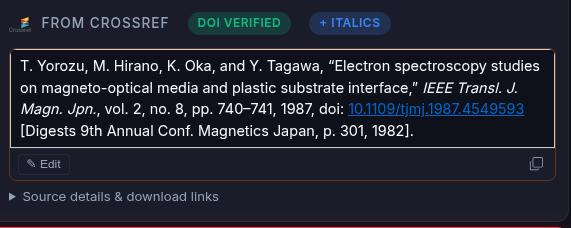
Source Details Expanded
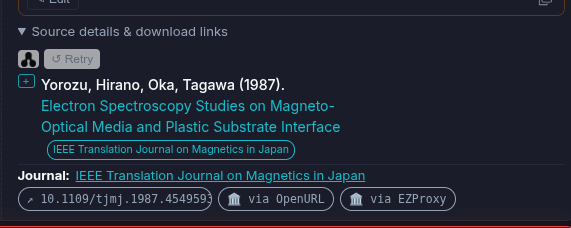
Here’s what is now hidden by default. If you’re really checking out a paper, having these download links available can save a bunch of clicks. Clicking on the article title gives expanded info about the article, including articles citing it and (if you scroll down) what it cites.

Book chapters get their editors
For chapter references, RefRunner can now find the book’s editors via the ISBN and Open Library — one of the hardest things to get right in a chapter citation.
More forgiving matching
A bunch of edge cases have been identified and corrected. Parsing what is essentially free-form text has a bunch of complications, worse, the metadata in Crossref and OpenAlex is often imperfect in many ways. Hundreds of such cases have been identified, but there are still more to find. If you find one, please let us know!
- A wrong first initial on an otherwise perfect title match is now a warning, not a rejection.
- Page ranges like “pp. 1930–1940” are no longer misread as publication years (which used to make perfectly good references fail the year check).
- Corporate authors (like “World Health Organization”) are kept intact in citations instead of being mangled into surname/given-name pieces.
- Compound surnames are no longer split apart.
- References with 1800s publication years parse correctly.
Paper Parsing improvements
- Vancouver/AMA reference lists are now parsed, with author-mismatch flagging.
- URLs that got split across lines (very common in PDF files) are rejoined.
- Quoted-title references are recognized even when your paste has no “References” heading. I’ve noticed quite a few papers that had this issue; I’m hoping that RefRunner will now reliably recognize when the paper stops and the references start.
- Pasting a whole reference list into the live search box now routes it to the checker instead of live search.
- PDF reference extraction got much more accurate, especially for two-column layouts.
Small fixes that make things smoother
- MDPI-style article numbers are prefixed with “Article” instead of looking like weird page numbers.
- “Accessed:” dates are updated in place instead of a duplicate being appended.
- Stray trailing periods no longer sneak into journal titles.
- Saved sessions are more reliable — additions from live search now persist.
As always, if RefRunner gets something wrong, hit the “RefRunner got this wrong?” button on the card and we’ll take a look.