RefRunner is new and I’m eager to support its users. If you need something that is missing, let me know, and there’s a good chance I’ll add whatever is missing. Here’s what was added to RefRunner when a user who needed IEEE formatting signed up.
My Ph.D. is in Education, which uses APA, so I’ve added support for styles other than APA as I’ve found need for them. We’ve added full support for IEEE-style papers—if you write or review for IEEE conferences or journals, RefRunner can now check your references end to end.
IEEE citation style, in and out
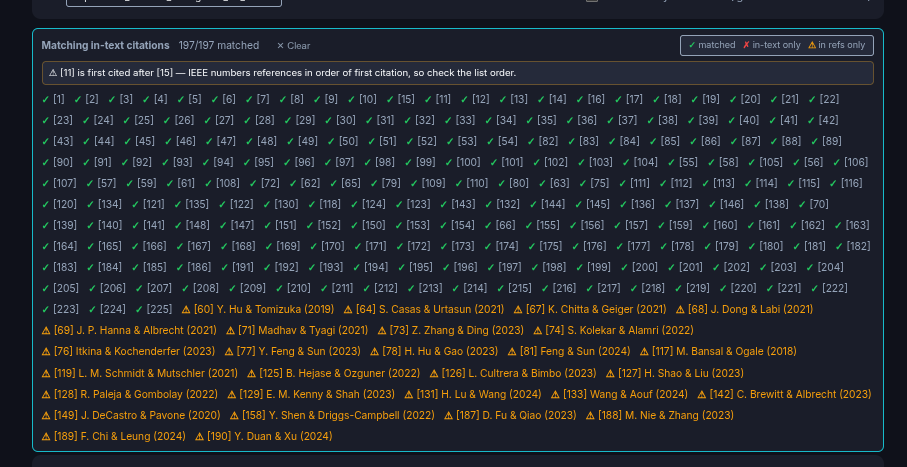
RefRunner now parses IEEE-formatted reference lists (the [1]-numbered, initials-first kind) and can output corrected references in IEEE style. It also checks your numeric [n] in-text citations against the reference list, so uncited and missing entries get flagged. Here’s the display from a test I did on a preprint. The yellow ones are in the references but never mentioned in the text. There is also a warning that [11] is first mentioned after [15]; those are things easy for an author to miss, and unlikely for and editor or reviewer to notice.
Works with the official IEEE templates
Upload a paper written in IEEE’s official conference template and it Just Works—including documents saved in the ISO Strict OOXML format that the template uses, which many libraries fail to parse correctly. RefRunner also skips the template’s instructional prose so it doesn’t get mistaken for references, and there’s an IEEE sample document on the demo page if you’d like to see it in action.
Much better IEEE PDF extraction
I’ve avoided advertising support for PDF files since they are much more difficult to parse than Word documents, but to have IEEE examples to work from, I was forced to improve the PDF parsing to be able to have some examples to test. We ran a batch of real published IEEE-format PDFs through RefRunner and fixed everything we found. The big one: two-column IEEE layouts are now detected reliably, which took some test papers from zero references extracted before this upgrade to finding all references after the update. We also now handle IEEE Access’s doubled-single-quote title glyphs (''like this''), numbered section headings (“7. REFERENCES”), the very long author lists IEEE requires (every author, no “et al.”), and place names like “London, U.K.:” that used to confuse the parser.
IEEE-specific reference types
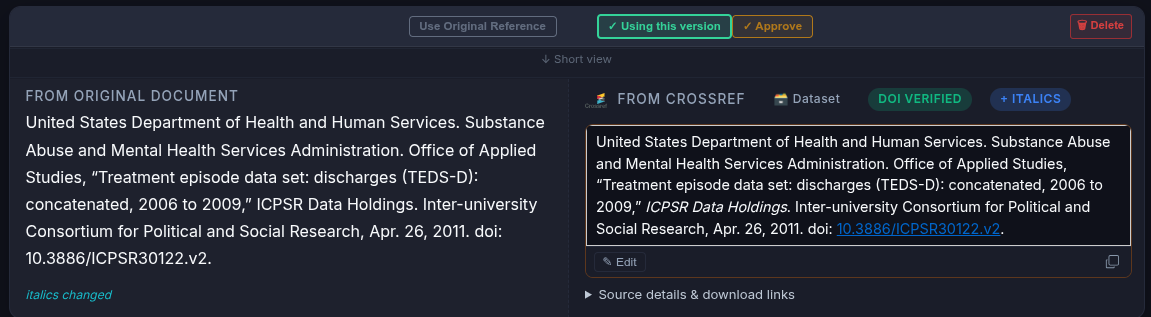
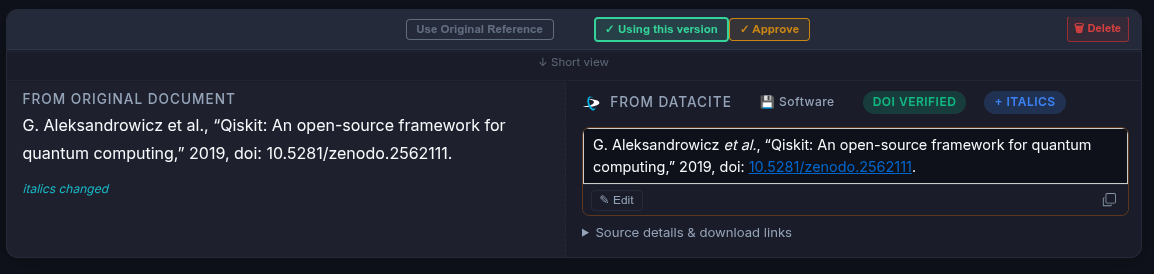
Dataset references, software citations, and translated-journal references (with their bracketed translations and language tags) are all handled properly now.
Translated Article
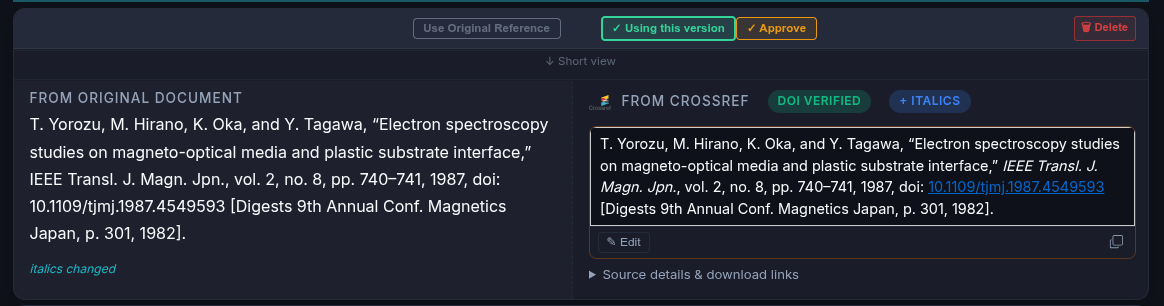
Note that the translation information is not available in the metadata, so after RefRunner formats the reference, it pulls the [original source] from what the author supplied. Though it’s impossible to verify everything, we try hard not to make things worse.
Dataset
Software
Smarter checking for IEEE quirks
- Book titles that publishers deposit into metadata in sentence case are converted to the Title Case that IEEE expects. Conference titles are not corrected; IEEE examples include the full conference names.
- Since IEEE puts initials first, RefRunner now checks the cited first initial against the database record and warns you when they don’t match.
- Titles ending in ? or ! no longer get a spurious comma after them in formatted output (“…BERT?,” → “…BERT?”).
Try it with your own paper at refrunner.com, or load the IEEE sample on the demo page.